← Back to work

CycurID · 2022

Imme: identity verification, reimagined for mobile.

A mobile KYC (Know Your Customer) app that lets people onboard with partnered businesses inside a closed, secure ecosystem, so their personal data stays safe even if a partner's systems are breached.

Role
Lead UX Designer · Sole designer on the project
Timeline
2022
Team
Solo designer · owners + a developer
Tools
Figma
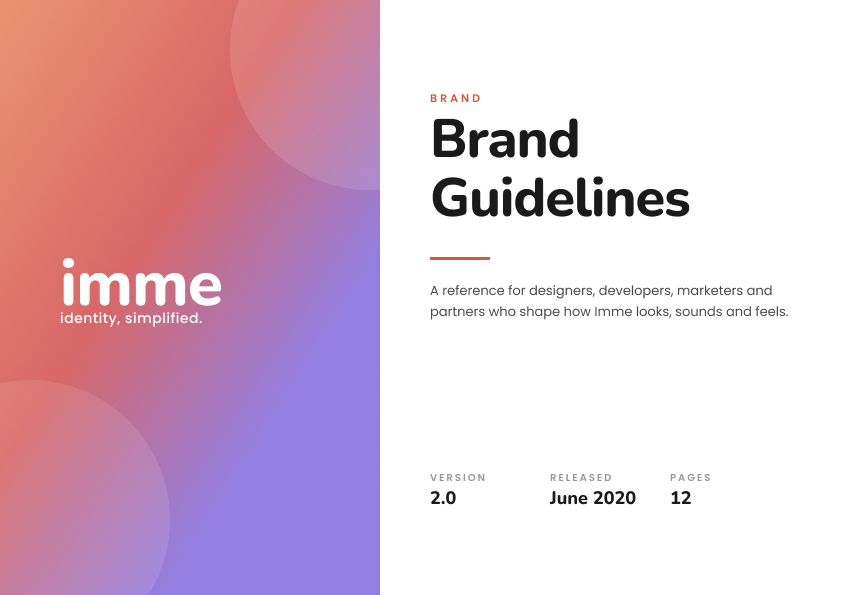
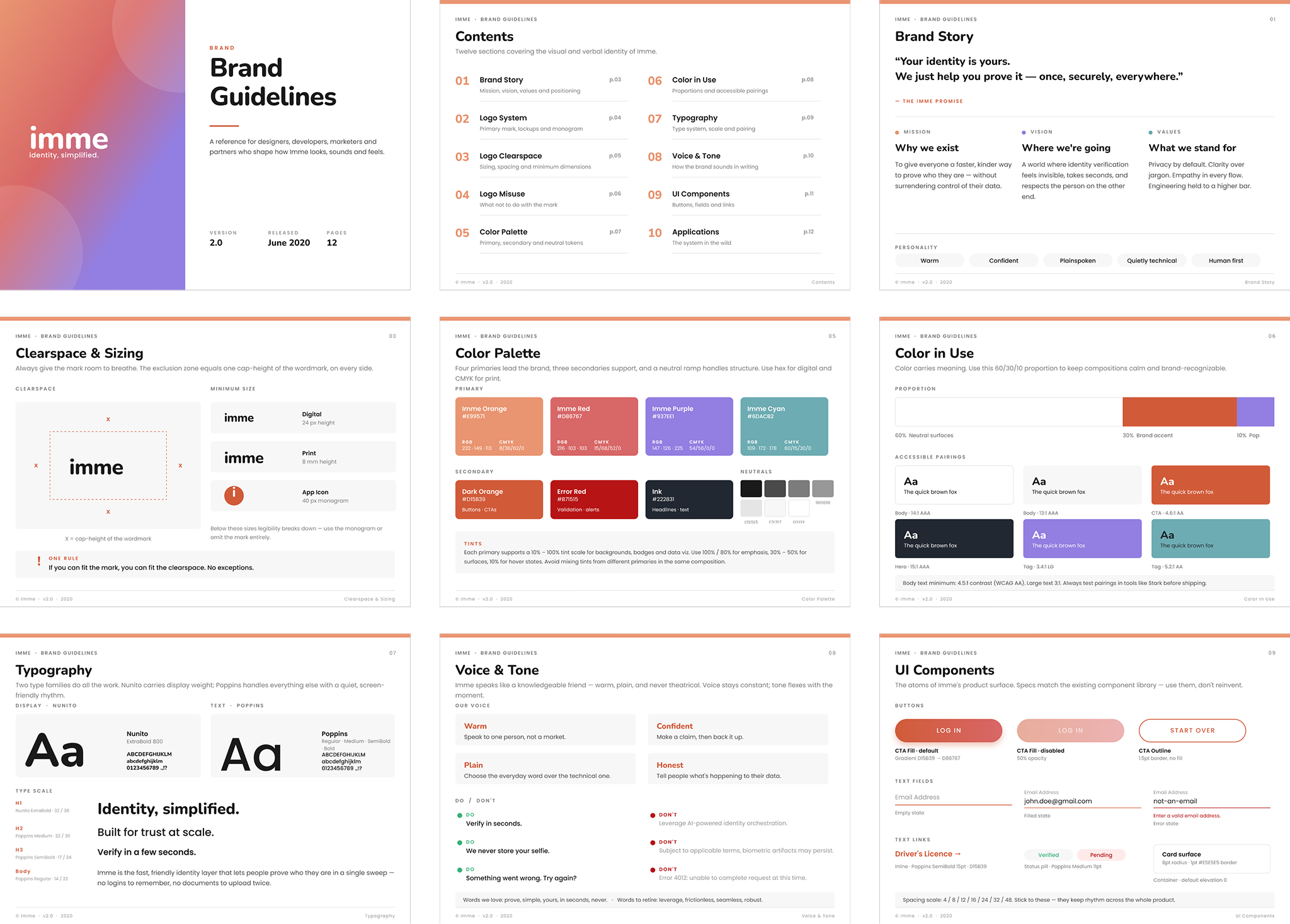
Imme brand guidelines cover

01 · The project

Identity verification, without the data trail.

The goal of the Imme app, first and foremost, is to let users onboard with partnered businesses. This process is what's known as a KYC (Know Your Customer) service in the industry. But Imme re-imagines KYC by creating a closed and secure ecosystem: the process happens without sharing identifiable data about the user with partnered companies.

The result: personal information stays safe even in the event of a data breach to a partner's security system. Identity gets verified; identifiable data doesn't get exposed.

Part 1 · The Imme app

Discover, define, develop, deliver.

Before jumping into mockups, I had to understand the space I was designing for, what was already out there, and where Imme actually fit. The work below follows roughly the Double Diamond, with the messy parts kept in.

02 · Discover · Competitive analysis

Learning the KYC space first.

I started by researching existing competitors in the KYC space, and asked the owners how they saw Imme situated within the existing market. Looking at what was and wasn't working in shipped products gave me a starting point for my own mockups, and let me ask sharper questions back to the owners about what Imme should and shouldn't try to be.

03 · Define · Initial process

Two concepts to argue over.

For the first round I looked at user flows from KYC competitors but also at products in the bitcoin, banking, and other fintech spaces, for inspiration on what people are already used to seeing in a finance- adjacent app. The initial designs were a starting point for a real conversation with the owners about what we wanted users to see on open, and how we, as a business, wanted to direct attention.

Two proposed home screen concepts for Imme, both featuring colourful gradient cards

04 · Develop · User pain points

Investor wants vs. user reality.

We settled on a direction and built the rest of the app around the agreed user flow. The design itself wasn't the problem. The problem showed up when we demoed it to two very different audiences.

We took the feedback back to the team and revisited our onboarding process and the landing screen of the app, prioritising the friends-and-family feedback first since the onboarding friction risked killing the funnel before users ever saw the rest of the product.

05 · Develop · Onboarding improvements

From six steps to three.

The initial onboarding involved 6 major steps, including scanning a government-level ID (passport or driver's licence) and cross-referencing it by linking a bank account. However, through testing with friends and family, along with peers of several of our stakeholders, we identified that these 6 lengthy, but necessary steps were creating a negative experience even prior to opening the app and experiencing the product.

Before · 6 steps

Email
Phone
Bank
Verification
ID
Verification
Liveness
Verification
Pattern
Passcode

After · 3 steps

Email
Phone
Liveness
Verification

We shortened the process to three simple steps: email, phone number, and a liveness detection. Bank verification, ID verification, and the pattern passcode all moved post-login, where users can complete them on their own time.

As a result, users are able to access the product much quicker than before, but still are required to complete the necessary steps if they wish to interact more with the app its features.

06 · Develop · Iterations

Restructuring the landing page around real first-time use.

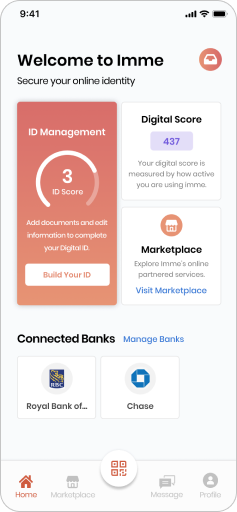
The revised landing page focuses on getting first-time users introduced to the main features of the app, rather than presenting them with a gallery of cards and no obvious next step.

The main emphasis is upload documents: the more documents a user uploads, the more identifiable information gets verified inside the closed ecosystem. The option to connect a bank account is surfaced alongside it, so users can purchase items and transfer or receive funds from friends and family without leaving the app.

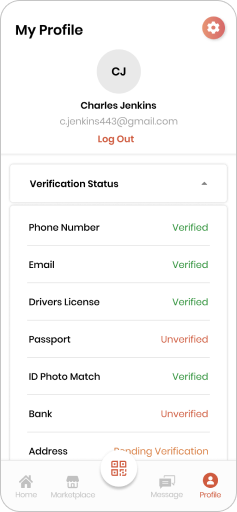
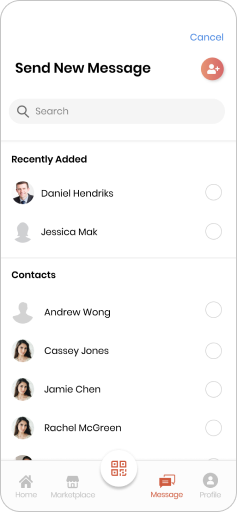
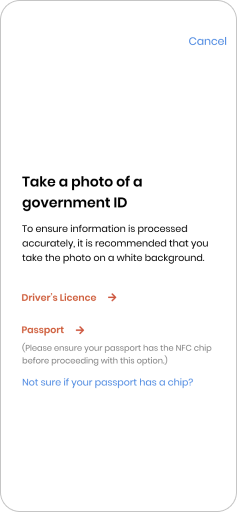
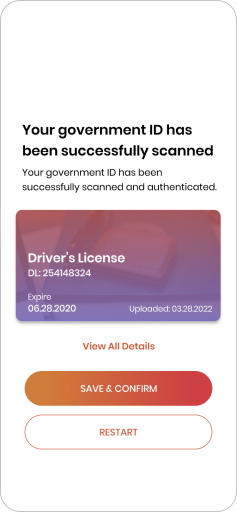
Multiple mobile mockups of Imme, including home screen, message feature, profile, government ID upload, and driver's licence and passport scan flows

07 · Deliver · The shipped flow

Onboarding, document upload, and verification.

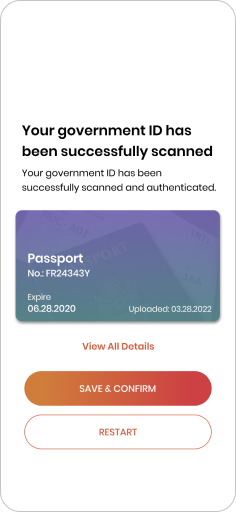
The shipped experience covers the full identity verification flow: government ID upload, driver's licence scan (front and back), passport scan (barcode and NFC), and a verification status screen that shows users how complete their identity profile is. A messaging feature and profile screen support the wider closed ecosystem.

Imme walkthrough Video coming soon
Imme · end-to-end walkthrough

Part 2 · The CycurID training app

A second app, just to get users ready for the first one.

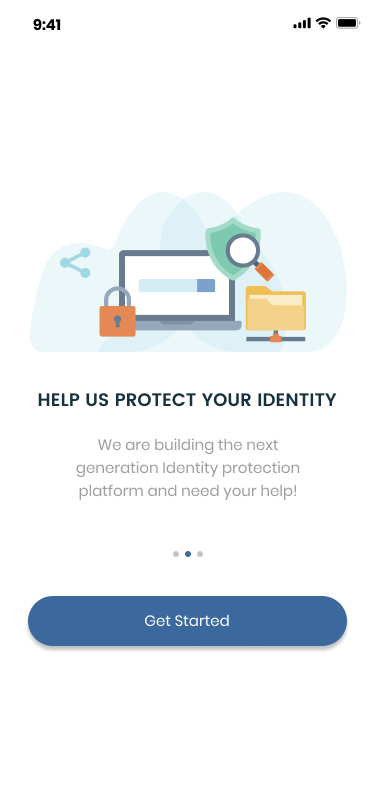
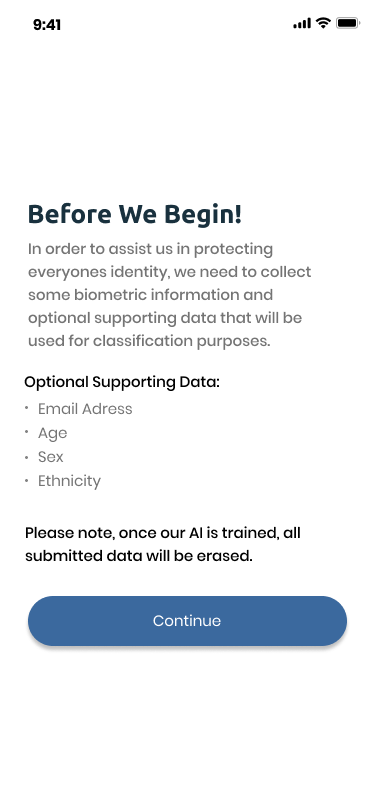
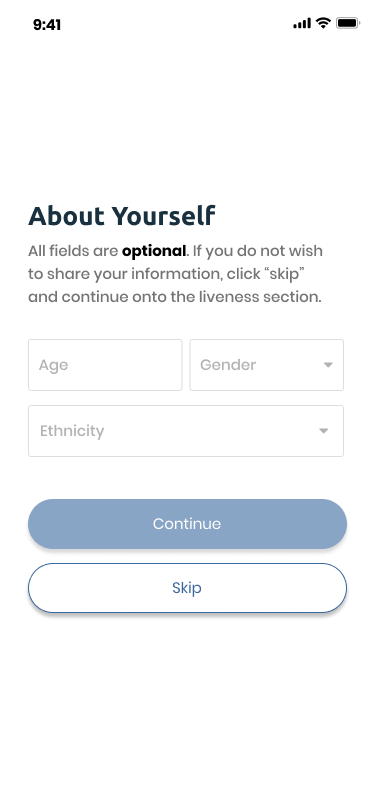
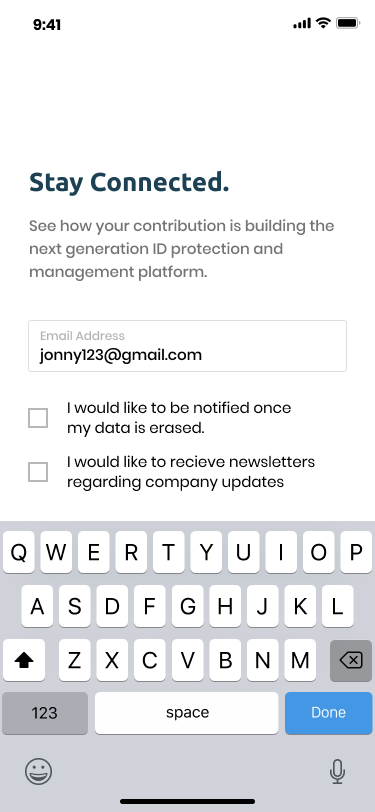
Imme's verification flow asks users to scan IDs, capture biometrics, and trust a process they don't fully understand yet. A second app, the CycurID training app, exists specifically to walk new users through what they're about to do, why their data stays safe, and what to expect at each step.

The training app sits in front of Imme. It earns trust before the real onboarding asks for it.

Training walkthrough Video coming soon
Training app · full walkthrough

08 · Training app · key screens

A short, calm walkthrough.

Five screens stitched together as a guided intro. The tone is reassuring, the buttons are big, and the copy keeps reminding users that nothing is stored or shared beyond what's needed to train the verification model.

Part 3 · Working with the team

How the work actually got built.

09 · Working with stakeholders

Owners on one side, the developer on the other.

Throughout the project I worked primarily with the owners to establish direction and purpose at each stage of the user journey, and with the developer to hand off the designs in an organised, low-friction way.

10 · Beta launch

What shipped.

Imme went into beta with the revised onboarding, the document upload flow, the licence and passport scanning, and the verification status screen. The CycurID training app shipped alongside it as the front door for new users.

11 · Reflection

What I'd carry forward.

The biggest lesson from this project was about which feedback to act on first. Investor feedback wanted more; user feedback wanted less. Both were valid, but acting on the user feedback first protected the funnel and made the investor conversation easier later, because we could point to a flow that real people had actually managed to finish.

The two-app structure (training + main) is something I'd reach for again on any product that asks for unusual trust on first use.

Next project

Event Categorization: bringing order to network alerts